 Start a projectStart a project
Running an AI studio, from a composer’s chair
The stage
Monaco’s first AI film festival, days after the Grand Prix, in the heart of Monte Carlo
On 9–10 June 2026, One Monte-Carlo hosted the Principality’s first festival devoted to AI-driven cinema, organized by WAIB Summit and backed by Alibaba Cloud, Microsoft, and ElevenLabs. Its manifesto, “Where Creator Meets the Creation,” asked the question hanging over the whole room: when machines can write, direct, and stir emotion, does the soul of human creativity fade, or expand?
Across two days it ran keynotes and panels, a curated programme of AI-made and AI-assisted films, a 24-hour film hackathon, a beach screening on the Larvotto shoreline, and an awards night spanning everything from Best AI Film to Best Brand Film. The jury pulled from both worlds, a Netflix series director, a machine-learning professor from UCL, Cinesite’s generative-AI lead, so the work was judged as cinema, not novelty.
The panel
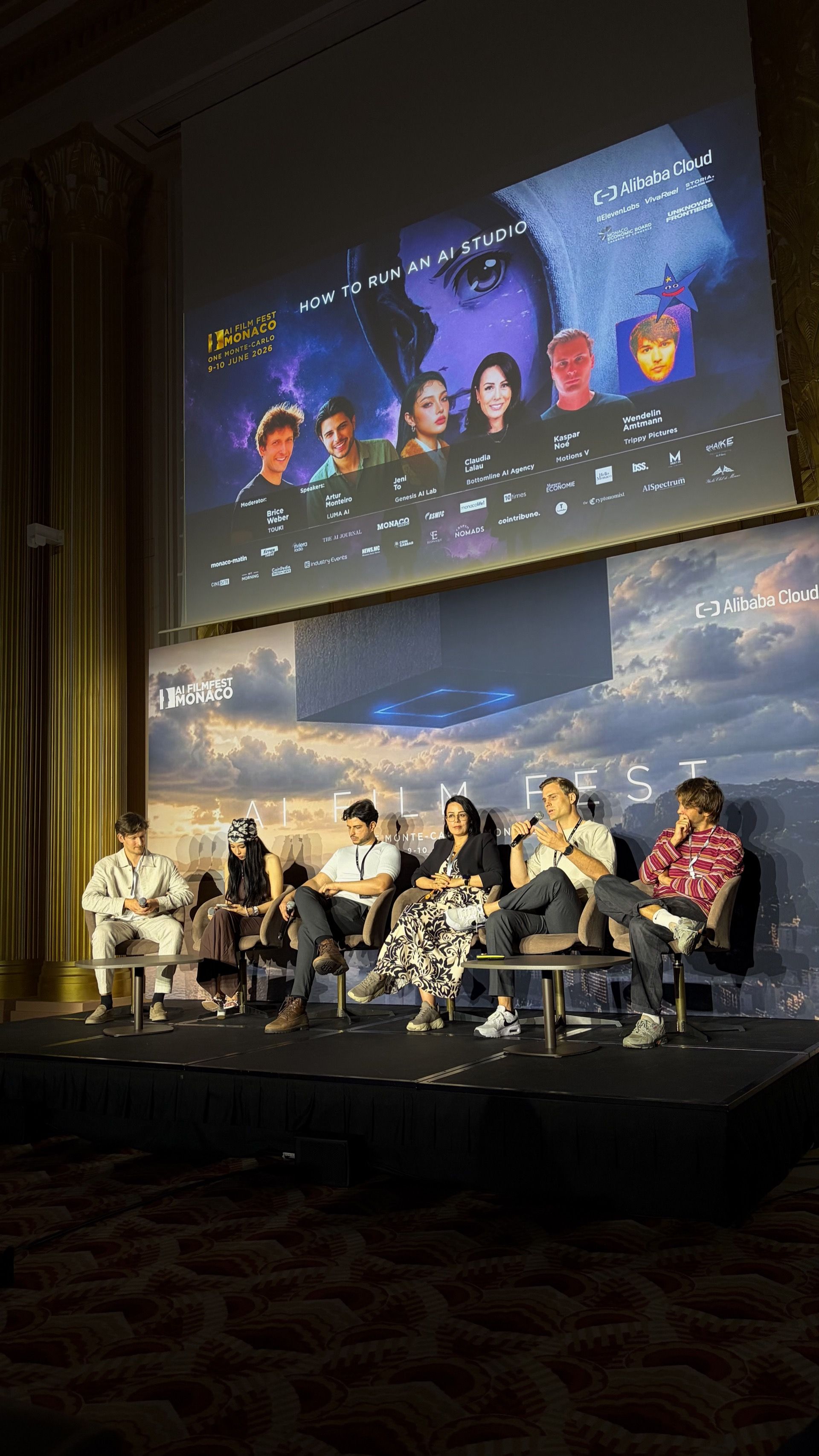
Kaspar took the stage to argue one thing: stay the composer, don’t become the prompt manager.
Speaking as a composer and Music Director of the global creative studio Motions V, Kaspar joined an international panel, moderated by Brice Weber, on how to build and run a creative studio in the age of AI - bringing the conversation to music, and how AI is transforming production and composition. His position cut through the hype and the fear alike: AI removes friction and handles the scale, but unguided it tilts your creativity - it decides, and you follow. The meaning still has to come from a person, and the discipline is in refusing that trade.
“AI handles the scale. I handle the meaning.”
He closed with a standard he proposes for the whole industry, three questions before any AI tool touches professional work: Where was this model trained? Do I legally own what it produces? And could I have made something equally good without it? If you can’t answer all three, you’re not using a tool, you’re outsourcing your judgment.
On stage
The distinction
AI can write to a brief. It can’t yet write to a feeling no one can name
Advertising music is functional, a tempo, a mood, a duration, and AI is genuinely good at it, because success is easy to define. Film scoring is something else: you serve a director’s interior vision, often something they can’t fully put into words, and translate narrative subtext into sound. That gap, between a brief and a feeling, is exactly where the difference lives, and where the human still wins.
“Before the sync button, being a DJ meant something. Then, overnight, everyone was a DJ. AI is at that same crossroads, and the discipline is worth protecting.”
How he actually uses it
Not a machine that spits out finished tracks. An assistant, wired into the studio
The point Kaspar made from the stage: the interesting use of AI in music isn’t typing a prompt into Suno and letting it write the song. It’s running an assistant like Claude as a layer connected to your DAW, doing the work a studio runner used to do, and a few things no one could do before.
Prepping and cleaning up sessions, organising and colour-coding tracks, setting the room up before a take, the grunt work that used to eat the first hour of every session.
Capturing real sounds out in the world and bringing them straight back into the session, a personal palette no sample pack can sell you.
Turning a captured or imagined sound into a playable soft synth, a VST you perform live on a MIDI keyboard. Not choosing presets, building the instrument.
Having it analyse a sound’s frequency response and harmonics, then rebuilding that exact character inside a synth, recreating in minutes a tone that once took hours of sine waves and guesswork.
Why it matters
The room was full of people either afraid of AI or in love with it. Kaspar is neither
His authority on the subject is practical, not theoretical: he scores for German and Italian television, markets whose contracts now demand guarantees about how music is made, while building AI-assisted sonic-branding workflows at Motions V for brands across Europe, the Middle East, and Asia. Few people work on both sides of that line. Fewer still can explain it from a stage.
Details